- 15th Feb '26
- Conversion Blitz
- 26 minutes read
- Author: Conversion Blitz
Keyword Golden Ratio Explained
 Over +200 features to generate leads!
 Over +200 features to generate leads!
 Over +200 features to generate leads!
Keyword Golden Ratio Explained: The Complete Guide to Finding Keywords You Can Actually Rank For
If you have ever spent weeks writing a blog post only to watch it vanish into the depths of Google's search results, you are not alone. Most website owners target keywords that are far too competitive, then wonder why the traffic never arrives. The Keyword Golden Ratio (KGR) offers a smarter path. It is a data-driven keyword research method that helps you find low-competition, long-tail keywords your site can realistically rank for — often within days, not months.
Developed by SEO practitioner Doug Cunnington, the KGR formula compares the number of pages intentionally targeting a keyword against the number of people searching for it. When demand outpaces supply, you have an opportunity. And with a tool like RankingTurbo, you can automate the entire process instead of manually juggling Google searches and spreadsheets.
In this guide you will learn exactly what the keyword golden ratio is, how the formula works, how to calculate KGR scores step by step, where the method shines (and where it falls short), and how to build a full content strategy around KGR keywords in 2026.
Key takeaways at a glance:
-
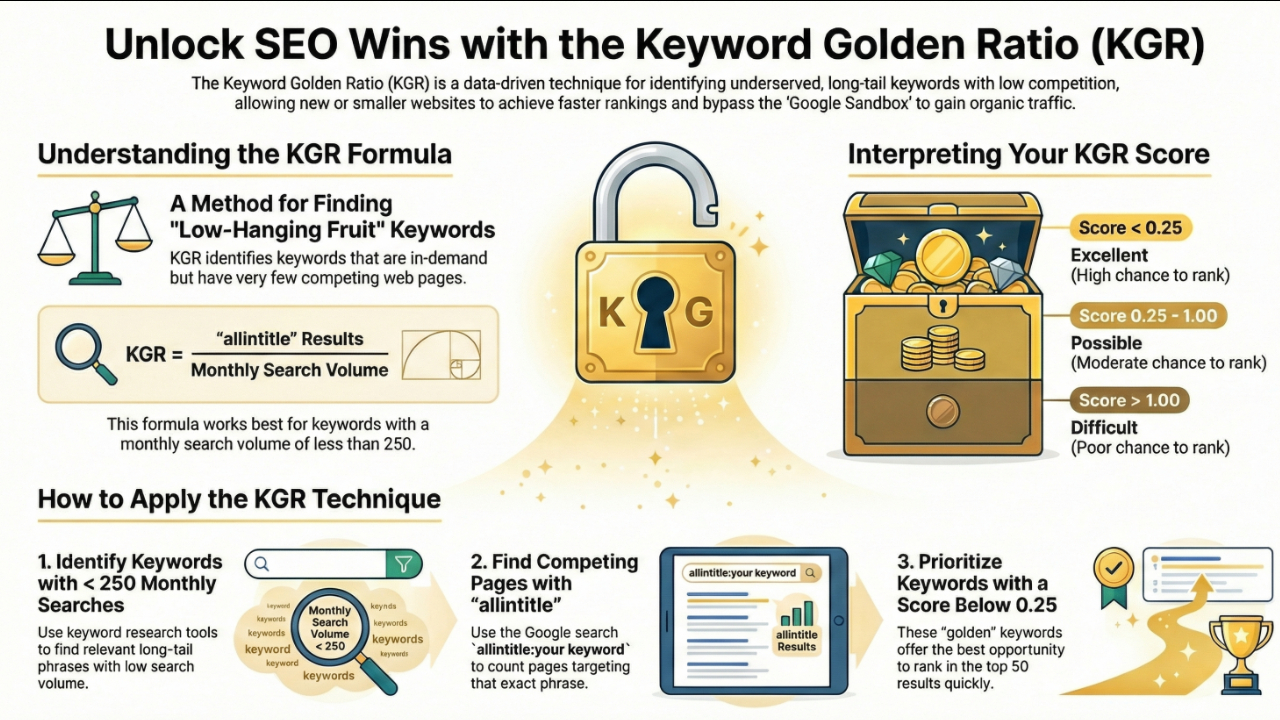
KGR formula: Allintitle Results ÷ Monthly Search Volume
-
Target score: Below 0.25 for the best ranking potential
-
Search volume cap: 250 monthly searches or fewer
-
Best for: New websites, niche sites, and anyone targeting long-tail keywords
-
Fastest workflow: Use RankingTurbo for instant KGR scoring with a single click
What Is the Keyword Golden Ratio (KGR)?
The Keyword Golden Ratio is a keyword research technique created by Doug Cunnington, the founder of Niche Site Project. He introduced the concept in 2017 as a way to help website owners — especially those running newer or smaller sites — find keywords that have very little competition relative to the number of people searching for them.
At its core, KGR is about supply and demand. If a keyword has plenty of people searching for it but only a handful of pages specifically optimized for it, there is a content gap. By creating a well-written article that targets that gap, you can often land on the first or second page of Google results in a matter of days rather than waiting months.
The method focuses on long-tail keywords — typically phrases of three to five words — with relatively low monthly search volumes. These are the keywords that larger, more authoritative sites often ignore because the individual traffic numbers seem too small. But when you target dozens of these keywords with quality content, the cumulative traffic adds up quickly.
One important distinction: KGR is a filter, not a guarantee. It helps you pick fights you can win, but you still need quality content, solid on-page SEO, and a topic that matches what the searcher actually wants. Think of it as the first step in a smarter keyword strategy, not the only step.
The KGR Formula Breakdown
The keyword golden ratio formula is straightforward. You only need two numbers:
KGR = Number of Allintitle Results ÷ Monthly Search Volume
Here is what each component means:
-
Allintitle results — The total number of Google search results that contain your exact keyword phrase in the page title. You find this by typing allintitle:your keyword phrase into the Google search bar. This number represents the pages that are intentionally trying to rank for that keyword.
-
Monthly search volume — The average number of times people search for that keyword each month. For the KGR method to work as intended, this number should be 250 or fewer. You can find search volume using tools like Google Keyword Planner, Ubersuggest, Ahrefs, or RankingTurbo.
Dividing the first number by the second gives you the KGR score. The lower the score, the less competition there is relative to demand.
Understanding KGR Score Ranges
Not all KGR scores are equal. The table below shows how to interpret your results and what action to take:
| KGR Score | Competition Level | What It Means | Recommended Action |
|---|---|---|---|
| Below 0.25 | Low | Very few pages are targeting this keyword relative to demand. High chance of ranking in the top 50–100 results quickly. | Target immediately. Publish quality content and expect fast results. |
| 0.25 to 1.0 | Moderate | Some competition exists, but ranking is still achievable, especially for sites with established authority. | Worth targeting. May require stronger content or a few backlinks. |
| Above 1.0 | High | More pages are targeting this keyword than people are searching for it. The supply exceeds demand. | Avoid or deprioritize. Focus your effort on lower-KGR alternatives. |
The sweet spot is a KGR score below 0.25. At that threshold, with a maximum search volume of 250, you are competing against fewer than 63 pages that have the keyword in their title. That is a fight most websites can win.
How to Calculate the Keyword Golden Ratio (Step-by-Step)
Calculating KGR manually is simple in theory but tedious in practice. Here is the full process broken down into four steps. At the end, you will see how RankingTurbo collapses all of this into a single click.
Step 1 — Find Seed Keywords in Your Niche
Start by brainstorming keyword ideas related to your topic or business. The goal is to generate a broad list before filtering it down. Some reliable methods include:
-
Google Autosuggest — Start typing a phrase into Google's search bar and note the suggestions that appear. Formats like "best [product] for [user type]" and "how to [action] with [tool]" tend to surface great long-tail candidates.
-
People Also Ask boxes — When you search for your main topic, Google often shows a "People Also Ask" section. These questions are real queries from real users and make excellent KGR keyword candidates.
-
Competitor blog analysis — Look at what topics your competitors have already covered. Their existing content can reveal keyword angles you have not considered.
-
Related searches — Scroll to the bottom of any Google results page for additional keyword ideas.
At this stage, do not worry about filtering. Just collect as many relevant keyword ideas as possible.
Step 2 — Filter for Low Search Volume Keywords (Under 250)
Next, run your keyword list through a search volume tool. Google Keyword Planner, Ubersuggest, Ahrefs, and SEMrush all provide monthly search volume estimates. You are looking for keywords with 250 or fewer monthly searches.
This cap might seem low, but it is intentional. Keywords below 250 searches tend to have significantly less competition. Larger sites rarely bother optimizing content for these terms, which is exactly what creates the opportunity for you. Once you build authority by ranking for many of these terms, you can gradually move up to higher-volume keywords.
Step 3 — Check Allintitle Results on Google
This is the most time-consuming step when done manually. For each keyword on your filtered list, you need to find the number of Google results that include that exact phrase in the page title. Here is how:
-
Open Google
-
Type allintitle: followed by your keyword phrase with no space after the colon — for example, allintitle:best crm for freelancers
-
Look at the total number of results displayed at the top of the search results page
That number is the allintitle count and serves as the numerator in the KGR formula. It tells you how many pages on the internet are specifically targeting that keyword in their title tag.
Pro tip: Google may limit rapid allintitle searches if you run too many in a short period. This is one of the biggest reasons people turn to automated KGR tools — doing this manually for 50 or 100 keywords can take an entire day.
Step 4 — Calculate and Interpret Your KGR Score
Now plug both numbers into the formula. Here is a worked example:
Target keyword: "best crm for freelancers"
-
Allintitle results: 12
-
Monthly search volume: 90
-
KGR calculation: 12 ÷ 90 = 0.13
A KGR score of 0.13 is well below 0.25, making this an excellent keyword to target. You would create a comprehensive article about CRM tools for freelancers, include the keyword in the title, and expect to rank quickly with quality content.
With RankingTurbo, this entire four-step process takes seconds. Enter a keyword, and the tool instantly calculates the KGR score, shows a clear go / maybe / tough verdict, and displays a SERP competitor preview so you can verify the opportunity before you write a single word.
Our platform provides a suite of lead generation tools designed to help you grow your company. You can find leads, send targeted emails, create a chatbot, and more, all within our comprehensive suite of products. These tools are tailored to enhance your marketing strategies and support your lead generation efforts effectively.
- Get unlimited data upload
- Unlimited usage to all products
- Unlimited leads to find
Why the Keyword Golden Ratio Works (The Logic Behind It)
The KGR method works because it exploits a fundamental truth about how Google operates: the search engine always needs to show results, even when very few pages are specifically optimized for a given query.
When someone searches for a long-tail keyword and only a handful of pages have that phrase in their title, Google has a limited pool of relevant results to display. If you publish a well-optimized, high-quality piece of content targeting that exact keyword, Google is likely to slot your page into those results quickly. There simply is not much competition standing in your way.
This contrasts sharply with targeting high-volume keywords where hundreds or thousands of pages — many on authoritative domains — are already competing for the same term. For a newer or smaller site, breaking through that wall of competition can take six months to a year, if it happens at all.
How KGR Helps New Websites Escape the Google Sandbox
New websites face what many in the SEO community refer to as the Google Sandbox — an informal probation period during which Google is reluctant to rank new domains highly for competitive queries. This period can last anywhere from three to six months, and it is one of the most discouraging phases of building a new site.
KGR offers a way around this problem. By targeting keywords where there are very few competitors, new sites can earn rankings and traffic even before their domain builds significant authority. These early wins serve a dual purpose: they bring in real visitors and signal to Google that the site produces relevant, useful content. Over time, these signals compound, making it easier to rank for progressively more competitive terms.
The Role of Allintitle as a Competition Signal
The allintitle count is the engine that makes the KGR formula work. It measures something very specific: how many pages have intentionally placed the exact keyword phrase in their title tag.
This is a much more precise competition signal than general Google result counts. A regular Google search for a keyword might return millions of results, but the vast majority of those pages are not deliberately targeting that phrase. They might mention some of the words incidentally or cover a related topic. The allintitle operator strips away that noise and shows you only the pages that are actively competing for the keyword.
When the allintitle count is low relative to search volume, it means there is real demand that is not being adequately met. That is your opening.
Real KGR Examples and Case Studies
Theory is useful, but concrete numbers are better. Below are three examples that illustrate how KGR works in practice — including one example of a keyword that looks good on paper but should be avoided.
Example 1 — Informational Keyword
Keyword: "how to clean a mechanical keyboard at home"
-
Allintitle results: 8
-
Monthly search volume: 110
-
KGR: 8 ÷ 110 = 0.07
This is a strong KGR keyword. The score is well below 0.25, the search volume is healthy, and the intent is clearly informational. You would create a step-by-step cleaning guide with tips, product recommendations, and images. This type of content can rank quickly and also attract links from related tech or productivity sites.
Example 2 — Buyer-Intent Keyword
Keyword: "best standing desk converter for small spaces"
-
Allintitle results: 15
-
Monthly search volume: 140
-
KGR: 15 ÷ 140 = 0.11
Buyer-intent keywords like this are especially valuable because the searcher is actively looking to make a purchase. An article reviewing the top standing desk converters for small spaces — complete with pros, cons, pricing, and affiliate links or product recommendations — could rank quickly and generate revenue.
Example 3 — A KGR Keyword That Looks Good But Is Not
Keyword: "best running shoes for beginners"
-
Allintitle results: 45
-
Monthly search volume: 210
-
KGR: 45 ÷ 210 = 0.21
The KGR score looks great at 0.21, but here is where SERP analysis becomes critical. If you search this keyword on Google, you will likely find the first page dominated by major retailers like Nike, Amazon, and REI along with authoritative health and fitness publications. These are high-authority domains with massive backlink profiles. Even though the KGR score qualifies, the real-world competition is fierce.
Lesson: Always Google the keyword before committing to it. KGR is a powerful filter, but it should be paired with a quick SERP check to confirm the opportunity is realistic. RankingTurbo includes a built-in SERP competitor preview for exactly this reason — so you can see what you are up against before you start writing.
Benefits and Limitations of the KGR Method
Like any SEO strategy, the keyword golden ratio has clear strengths and some important limitations. Understanding both will help you use it effectively.
Key Benefits of Using KGR
-
Uncovers hidden opportunities. KGR finds long-tail keywords that competitors overlook because of their lower search volumes. These are the content gaps that can drive consistent, targeted traffic.
-
Data-driven and repeatable. The formula removes guesswork from keyword research. You get a clear numerical score that tells you whether a keyword is worth pursuing.
-
Ideal for new and low-authority websites. By targeting keywords with minimal competition, newer sites can start ranking and building momentum before their domain authority catches up.
-
Fast results. Content targeting KGR-compliant keywords can rank in the top 50 within days of publication — sometimes even within 24 to 48 hours.
-
Budget-friendly. You can perform KGR research with free tools, though dedicated tools like RankingTurbo make the process dramatically faster and more efficient.
-
Compounds over time. Individually, each KGR keyword may drive modest traffic. But publish 20, 50, or 100 articles targeting different KGR keywords, and the cumulative effect is significant. Doug Cunnington's original case study demonstrated this when he published 200 KGR-focused posts over five months and grew a site from $100 to over $14,000 per month in revenue, with roughly 800 percent traffic growth.
Known Limitations to Keep in Mind
-
Limited to low search volumes. The formula is designed for keywords with 250 or fewer monthly searches. Using it for higher-volume keywords reduces accuracy.
-
Ignores competitor domain authority. KGR does not measure how strong the sites currently ranking for a keyword are. A low allintitle count is meaningless if the ranking pages belong to Wikipedia and Amazon.
-
Allintitle data can fluctuate. Google's allintitle results are not perfectly stable and can vary slightly day to day.
-
Not a standalone strategy. KGR helps you pick the right keywords, but it does not replace the need for high-quality content, on-page optimization, internal linking, and topical authority.
-
Requires scale to be impactful. A single KGR article will not transform your traffic. The method works best when you consistently publish content around many KGR keywords in your niche.
As RankingTurbo puts it: "KGR is a filter, not a guarantee." Always sanity-check the SERP, and always prioritize content quality.
Our platform provides a suite of lead generation tools designed to help you grow your company. You can find leads, send targeted emails, create a chatbot, and more, all within our comprehensive suite of products. These tools are tailored to enhance your marketing strategies and support your lead generation efforts effectively.
- Get unlimited data upload
- Unlimited usage to all products
- Unlimited leads to find
KGR vs. Keyword Difficulty: What Is the Difference?
If you have used SEO tools like Ahrefs, SEMrush, or Moz, you are probably familiar with keyword difficulty (KD) scores. These scores estimate how hard it will be to rank for a keyword based on the backlink profiles of the pages currently in the top results. You might wonder: why use KGR at all if keyword difficulty scores already exist?
The answer is that KGR and KD measure completely different things, and they complement each other well.
KGR looks at how many pages are intentionally targeting a keyword in their title. It measures optimization-level competition. KD looks at how authoritative the pages that already rank are, based primarily on their backlinks. It measures authority-level competition.
A keyword could have a low KD score but a high KGR score (many pages targeting it despite weak backlink profiles), or vice versa. Using both metrics together gives you a fuller picture of the competitive landscape.
| Factor | Keyword Golden Ratio (KGR) | Keyword Difficulty (KD) |
|---|---|---|
| What it measures | Number of pages with the keyword in the title vs. search demand | Backlink strength of currently ranking pages |
| Best suited for | New sites, long-tail and niche keywords | Established sites, head terms and competitive keywords |
| Data source | Allintitle count + monthly search volume | Backlink analysis of top-ranking URLs |
| Complexity | Simple formula anyone can calculate | Varies by tool; proprietary algorithms |
| Consistency across tools | Same formula everywhere | Scores differ significantly between Ahrefs, SEMrush, and Moz |
| Ideal use case | Finding quick-win content opportunities | Evaluating whether a high-value keyword is worth the investment |
The practical takeaway: use KGR to find quick-win keywords you can rank for immediately, and use KD to evaluate higher-value keywords as your site grows in authority. They work best together.
Best KGR Tools and How RankingTurbo Automates the Process
You can calculate KGR manually using nothing but Google and a free keyword tool. But anyone who has tried it for more than a handful of keywords knows the process is painfully slow. Each keyword requires a separate allintitle search, a separate volume lookup, and manual entry into a spreadsheet. Repeat that 50 or 100 times and you have lost an entire day.
That is why KGR tools exist — to automate the tedious parts so you can focus on creating content.
The Manual Method (Free but Slow)
If you are just getting started or working on a tight budget, you can calculate KGR for free:
-
Google search bar — Use the allintitle: operator to check competition for each keyword
-
Google Keyword Planner or Ubersuggest — Look up monthly search volume
-
Spreadsheet — Track keywords, allintitle results, search volumes, and calculated KGR scores in a Google Sheet or Excel file
This method works but does not scale. Expect to spend 5 to 10 minutes per keyword, and be aware that Google may throttle your allintitle searches if you do too many in a row.
KGR Tools and Chrome Extensions
Several tools have been built to speed up the KGR workflow:
-
Allintitle.co — A dedicated bulk KGR checker that automates allintitle lookups and search volume retrieval. Good for processing large keyword lists but may require a learning curve.
-
KWFinder (Mangools) — A keyword research tool with built-in difficulty metrics that can be combined with manual allintitle checks. Not KGR-specific but useful for the volume side of the equation.
-
Chrome extensions — Various browser extensions add KGR calculation functionality directly to your Google search results page. Convenient for one-off checks but limited for larger research sessions.
How RankingTurbo Streamlines KGR Research
RankingTurbo is purpose-built for KGR analysis. Instead of juggling multiple tools, tabs, and spreadsheets, you enter a keyword and get an instant answer:
-
Instant KGR scoring — One keyword, one click. RankingTurbo checks allintitle results, pulls search volume data, and calculates your KGR score automatically. Results are displayed with a clear go / maybe / tough verdict so there is no ambiguity.
-
SERP competitor preview — See what you are up against before you write. RankingTurbo shows a quick snapshot of the pages currently ranking for your keyword, helping you verify the opportunity is real.
-
Bulk keyword analysis — Paste keywords or upload a CSV to analyze many keywords at once. No more one-at-a-time manual searches.
-
Intent summary — Get a quick read on the search intent behind each keyword to ensure your content matches what the searcher expects.
-
Project organization — Save and organize your keyword research into lists as you build out content clusters.
-
Credit-based pricing — Plans start at $29 per month with 3 free daily analyses available to all users, keeping the tool accessible while maintaining fast, reliable data.
If KGR research is a regular part of your SEO workflow, RankingTurbo pays for itself in time saved on the very first session. Try it free here.
How to Build a Content Strategy Around KGR Keywords
Finding KGR keywords is only the first step. The real power of the method comes from building a systematic content strategy that uses KGR as its foundation and scales from there.
Start with KGR Keywords, Then Scale Up
The recommended approach, especially for newer websites, follows a clear progression:
-
Phase 1 (Months 1–6): Focus exclusively on KGR-compliant keywords with scores below 0.25 and search volumes under 250. Aim to publish 20 to 30 articles during this phase. Each piece brings in modest but real traffic, and collectively they begin to establish your domain's authority in Google's eyes.
-
Phase 2 (Months 6–12): As your site gains authority, start targeting keywords with slightly higher competition — KGR scores between 0.25 and 1.0, and search volumes up to 500 or 800. Your existing content and internal links give you a stronger foundation for these tougher fights.
-
Phase 3 (Month 12+): With a portfolio of ranking content and growing domain authority, you can begin competing for higher-volume keywords that drive significant traffic. The KGR groundwork you laid earlier makes this transition much smoother.
Organize KGR Keywords into Topical Clusters
Rather than publishing KGR articles as isolated, unrelated pieces, group them into topical clusters. A topical cluster is a set of related articles that all link to a central pillar page covering the broader topic.
For example, if your site is about project management software, your clusters might look like this:
-
Pillar page: "Complete Guide to Project Management Software"
-
KGR cluster articles: "best project management tool for freelancers," "how to use Gantt charts for small teams," "project management software for remote workers," "free alternatives to Asana for startups"
Each KGR article links back to the pillar page and to related cluster articles. This internal linking structure signals to Google that your site has topical authority in that area, which helps every page in the cluster rank higher.
RankingTurbo's project and list features make it easy to organize your keyword research by cluster as you go, so you always know which topics are covered and where gaps remain.
Content Quality Still Wins
KGR identifies the opportunity. Quality content captures it. Even with a perfect KGR score, a poorly written or shallow article will not rank well. For every KGR keyword you target, ensure your content meets these standards:
-
Match the search intent. If the searcher wants a how-to guide, give them step-by-step instructions. If they want product comparisons, deliver a thorough review. Check the current SERP results to understand what format Google prefers.
-
Optimize on-page elements. Include the keyword in the title tag, in the first 100 words, in at least one H2 header, and in the meta description. Use it naturally — once in the title and once in the body is enough. Avoid keyword stuffing.
-
Go deeper than competitors. If the top-ranking pages cover a topic in 800 words, write 1,500 words with more detail, better examples, and clearer structure. Give Google a reason to rank your page above the existing results.
-
Add supporting media. Tables, images, comparison charts, and step-by-step screenshots make your content more useful and more likely to earn featured snippets and AI Overview placements.
Our platform provides a suite of lead generation tools designed to help you grow your company. You can find leads, send targeted emails, create a chatbot, and more, all within our comprehensive suite of products. These tools are tailored to enhance your marketing strategies and support your lead generation efforts effectively.
- Get unlimited data upload
- Unlimited usage to all products
- Unlimited leads to find
Common KGR Mistakes to Avoid
The KGR method is simple, but there are several common mistakes that can derail your results. Watch out for these pitfalls:
-
Using regular Google results instead of allintitle. This is the most frequent error beginners make. A standard Google search for a keyword might return millions of results, but that number is irrelevant to KGR. You must use the allintitle: operator to find only the pages that have the keyword in their title. Without this, your KGR calculation will be wildly inaccurate.
-
Ignoring the 250 search volume cap. The KGR formula is calibrated for keywords with 250 or fewer monthly searches. Applying it to keywords with higher volumes introduces unpredictable competition levels and reduces the method's reliability.
-
Keyword stuffing your KGR terms. Long-tail KGR phrases can sound awkward when forced into content repeatedly. Best practice is to use the exact phrase once in the title and once in the body, then rely on natural variations and related phrases throughout.
-
Skipping SERP analysis. Never write content for a KGR keyword without first Googling it. Check the current results to confirm that the competition is manageable and that the search intent matches the content you plan to create.
-
Targeting irrelevant keywords. A KGR score of 0.10 is worthless if the keyword has nothing to do with your business or audience. Always prioritize relevance and commercial fit alongside the score.
-
Expecting overnight results from a single article. KGR delivers fast results relative to traditional SEO timelines, but it is not magic. The method works best at scale — 20 to 30 or more articles targeting different KGR keywords, published consistently over time.
Does the Keyword Golden Ratio Still Work in 2026?
This is one of the most common questions about KGR, and the short answer is yes — the keyword golden ratio still works in 2026. The core principle behind it — finding keywords where demand exceeds the supply of optimized content — is a fundamental market dynamic that does not change with algorithm updates.
That said, the SEO landscape has evolved since Doug Cunnington introduced the method in 2017, and your approach to KGR should evolve with it.
KGR and Google's AI Overviews
Google's AI Overviews (formerly Search Generative Experience) now appear at the top of many search results, synthesizing information from multiple pages into a single answer box. This changes the game for content creators in two important ways:
First, content that answers specific, well-defined questions — exactly the type of content KGR keywords tend to produce — is prime material for AI Overview citations. If your article clearly answers a long-tail query with structured, well-organized content, Google's AI is more likely to reference it.
Second, optimizing for AI Overviews means following the same best practices that make content rank well in traditional search: use clear headers, include tables for comparison data, bold key terms and definitions, use lists for step-by-step processes, provide concise summaries, add an FAQ section, and implement structured data schema markup. These are the elements highlighted in the AIO Rankings Cheatsheet, and they align perfectly with a KGR content strategy.
Semantic Search and KGR
Google's understanding of language has become much more sophisticated. The search engine now uses semantic analysis to understand the meaning behind a query, not just the exact words. This is sometimes cited as a reason why allintitle-based methods might be losing relevance.
In practice, the allintitle count remains a useful competition signal precisely because it measures intentional optimization. Pages with the keyword in their title are deliberately targeting that query. Semantic search improvements mean that Google may also rank pages that do not have the exact phrase in their title — but those pages are incidental competitors, not strategic ones. The strategic competition is still best measured by allintitle.
The practical implication is this: continue using KGR to identify your primary keyword targets, but also include semantically related terms throughout your content. If your KGR keyword is "best crm for freelancers," also work in related phrases like "freelance client management," "small business contact tracking," and "solo entrepreneur CRM tools." This gives Google more signals about the depth and relevance of your content.
Frequently Asked Questions (FAQ)
What is the keyword golden ratio formula?
The KGR formula is: KGR = Number of Allintitle Results ÷ Monthly Search Volume. Allintitle results are found by searching allintitle:your keyword on Google, which shows how many pages have the exact phrase in their title tag. Monthly search volume should be 250 or fewer for the formula to work as intended. If the resulting score is below 0.25, the keyword has low competition and strong ranking potential.
What is a good KGR score?
A KGR score below 0.25 is considered excellent. Keywords in this range typically have very low competition and can rank in the top 50 to 100 results within days of publication. Scores between 0.25 and 1.0 are moderate and still worth targeting, especially for sites with some existing authority. Scores above 1.0 indicate high competition relative to demand and are generally best avoided.
Does the keyword golden ratio still work?
Yes. The keyword golden ratio remains effective in 2026 because its underlying principle — identifying search terms with more demand than supply — is a timeless market dynamic. The method works best when combined with high-quality content, proper on-page SEO, topical authority, and a quick SERP check to verify the competitive landscape.
What does allintitle mean in KGR?
Allintitle is an advanced Google search operator. When you type allintitle: followed by a keyword phrase, Google returns only the pages that contain that exact phrase in their title tag. In the context of KGR, the allintitle count represents the number of pages that are intentionally optimized for that keyword. It is the numerator in the KGR formula.
How many KGR keywords should I target?
Most SEO practitioners recommend starting with 20 to 30 KGR keywords as an initial content foundation. Publishing consistently around these terms builds topical authority and generates compounding traffic. As your site grows, you can expand to 50, 100, or more KGR articles while also beginning to target higher-competition keywords.
Can I use KGR for keywords with more than 250 monthly searches?
The original KGR formula is designed for keywords with 250 or fewer monthly searches. You can use it as a directional guide for higher-volume keywords, but the accuracy and predictability decrease. Some practitioners apply the Rule of 63 — targeting any keyword where the allintitle count is 63 or fewer, regardless of search volume — as a modified threshold for more established sites.
What is the best keyword golden ratio tool?
RankingTurbo is purpose-built for KGR keyword research. It automates the allintitle check, retrieves search volume data, and delivers an instant go/maybe/tough score — all from a single keyword entry. It also includes a SERP competitor preview, bulk analysis via CSV upload, and project organization features. Three free analyses per day are available on all accounts.
Who invented the keyword golden ratio?
Doug Cunnington, the founder of Niche Site Project, created the Keyword Golden Ratio in 2017. He developed it as a data-driven method to help new and smaller websites find low-competition keywords they could rank for quickly. The method gained widespread adoption after Cunnington documented case studies showing significant traffic and revenue growth from KGR-targeted content.
Our platform provides a suite of lead generation tools designed to help you grow your company. You can find leads, send targeted emails, create a chatbot, and more, all within our comprehensive suite of products. These tools are tailored to enhance your marketing strategies and support your lead generation efforts effectively.
- Get unlimited data upload
- Unlimited usage to all products
- Unlimited leads to find
Start Finding Keywords You Can Actually Rank For
The keyword golden ratio is one of the most practical, accessible SEO methods available. It cuts through the complexity of keyword research with a simple formula that tells you whether a keyword is worth targeting — and it works especially well for newer websites, niche blogs, and anyone tired of competing against sites ten times their size for high-volume keywords.
The method is straightforward: find long-tail keywords with search volumes under 250, check the allintitle competition, calculate the ratio, and prioritize keywords with scores below 0.25. Publish quality content targeting those keywords, organize it into topical clusters, and watch your rankings and traffic compound over time.
The only friction point in the entire process is the manual work involved in checking allintitle results and search volumes one keyword at a time. That is exactly the problem RankingTurbo solves. Enter a keyword, get an instant KGR score with a clear recommendation, see the competitive landscape, and move straight to content creation.
Try RankingTurbo free — 3 keyword analyses per day, no credit card required.
Conversion Blitz
Our platform provides a suite of lead generation tools designed to help you grow your company. You can find leads, send targeted emails, create a chatbot, and more, all within our comprehensive suite of products. These tools are tailored to enhance your marketing strategies and support your lead generation efforts effectively.
- Get unlimited data upload
- Unlimited usage to all products
- Unlimited leads to find

 Tools to grow your business